Questions to Ask an Electrician Before Hiring Directly
Before hiring an electrician directly, ask about their state certification or trainee/apprentice status, how they are classified as a worker, their experience with jobs like yours, and the pay and scope of the job, because the individual doing the wiring must hold their own state certification or trainee or apprentice status. That certification is tied to logged job hours and a passed exam. An electrician may instead be actively enrolled in a state-approved Electrician Trainee program and registered as a trainee, or be indentured in an approved electrical apprenticeship, and any of these statuses should be confirmed directly with the person rather than assumed. Ask the electrician plainly whether they are state-certified, or which trainee or apprenticeship status applies to them, and ask to see documentation rather than taking a verbal answer at face value. Treat this as one of several questions you ask together, alongside worker classification, relevant hands-on experience with similar work, and pay and scope, so you come away with a full and honest picture of who will actually be doing the electrical work on your job site before you commit to hiring them.
Ask About the Electrician's Individual Certification Status
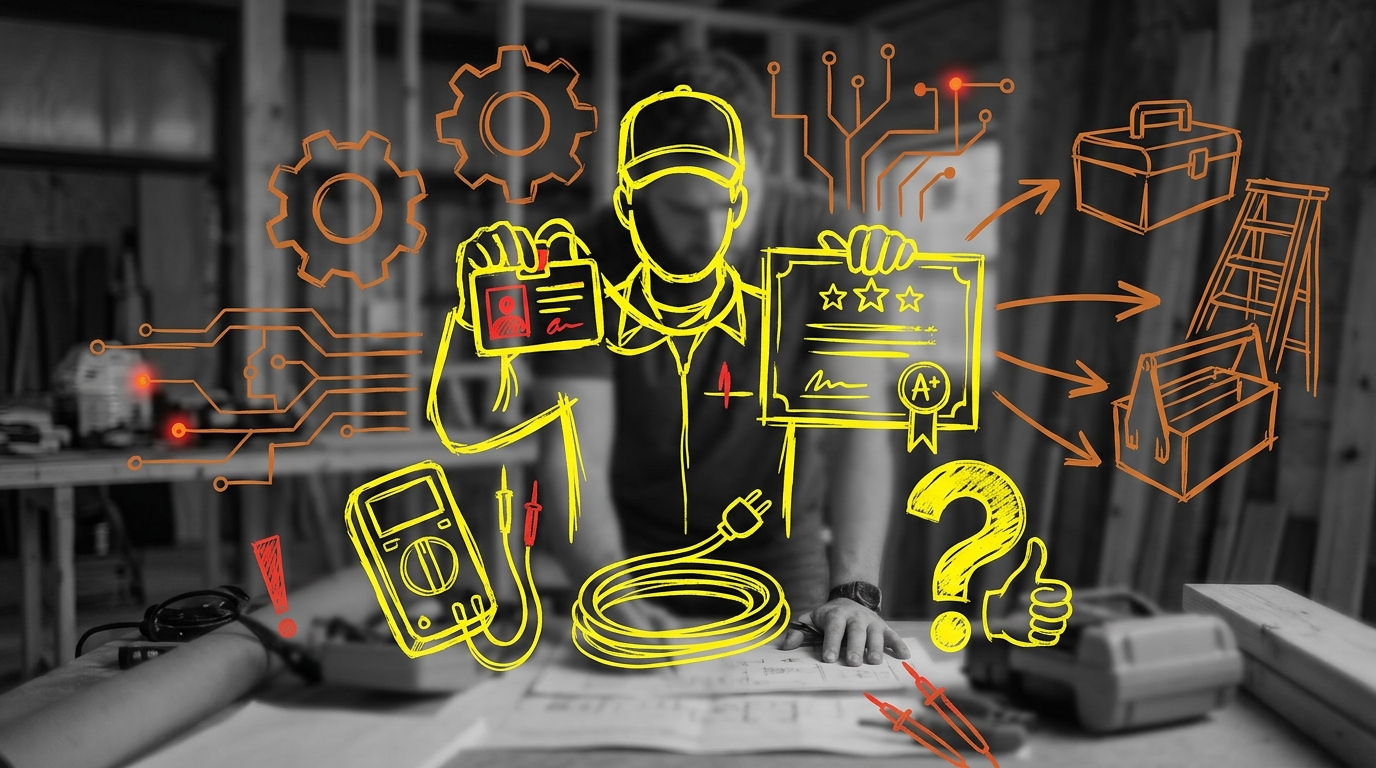
A crew can look qualified on paper while the person actually running wire on your job has never been checked. That's exactly why the first question you ask an electrician needs to be about them personally, not about the company. To work legally in California, an electrical worker must be state-certified, or enrolled in a state-approved Electrician Trainee program and registered as a trainee, or indentured in an approved electrical apprenticeship. Any of these three statuses lets a person do electrical work legally, so it's worth asking which fits the person standing in front of you rather than guessing.
A state-certified electrician is a California electrical worker certified by the state. Ask the electrician to confirm it and show documentation.
If you want a deeper walkthrough of how to verify these credentials rather than just ask about them, see the separate piece on checking an electrician's trade qualifications directly, which covers how contractors can check electrician trade qualifications.
Ask How They're Classified as a Worker
Certification tells you whether someone is qualified to do the work. Classification tells you what kind of working relationship you're actually entering into, and in California that question is more layered than it looks. California's EDD says that in the construction industry, a person doing the work may be a statutory employee, an employee under the ABC test, an employee under the Borello test, or an independent contractor (DE 231G Construction Industry). Which category applies depends on the specific facts of the arrangement, not on what either side calls it.
This matters because the test used to decide the question changed significantly in recent years. California's AB 5, signed into law in September 2019, adopted the ABC test to decide whether workers are employees or independent contractors under the Labor Code, the Unemployment Insurance Code, and the IWC wage orders (Independent contractor versus employee).
Construction, though, has its own carve-out worth knowing about. Under California Labor Code §2781, the ABC test and the Dynamex holding do not apply to a contractor's relationship with an individual working under a construction subcontract, as long as the contractor shows that every one of the section's listed criteria is met — and in that case, employee status is instead decided under Section 2750.5 and Borello.
None of this is legal advice, and when the stakes are high, this is where you lean on your own attorney or accountant rather than guesswork. But asking the electrician directly how they see their own classification, and whether they operate as a sole proprietor, through a business entity, or as part of a larger crew, gives you a starting point for a conversation that protects both sides.
Ask Questions That Reveal Real Experience
Once you've confirmed credentials and classification, the conversation shifts to whether this particular electrician has actually done work like yours before. A scattered conversation makes it hard to compare one electrician against another, which is why a structured approach pays off. An expert quoted by SHRM says behavioral interviewing must be structured — set questions delivered to every candidate in the same wording and order, scored the same way (Behavioral Interviewing Popular, but Training in Use Urged). Applied to hiring an electrician directly, that means writing your questions down ahead of time — about panel upgrades, service calls, new construction, EV charger installs, or whatever your job requires — and asking every candidate the identical set, in the identical order, so you're comparing real answers rather than vague impressions.
Part of that structured approach includes credentials beyond state certification. Electricians sometimes list OSHA Outreach training on resumes or applications, and it's worth knowing what each level actually signals. OSHA's Outreach Training Program offers 10-hour or 30-hour classes for construction, general industry, and maritime, plus a 15-hour class for disaster site workers (OSHA Outreach Training Program FAQs), and these courses are voluntary nationally — OSHA recommends them as an orientation to workplace safety and health, though some states have passed laws requiring the training. The 10-hour course is aimed primarily at entry-level workers (Program Overview), while the 30-hour program is built for workers who already carry some safety responsibility and need broader, deeper training. When you see either course on a resume or hear it mentioned in an interview, treat it as training a worker may list or you may ask about — never as a platform requirement.
| Course | Who it's for | Voluntary or required |
|---|---|---|
| 10-hour, 30-hour, and 15-hour classes for construction, general industry, maritime, and disaster sites | Varies by course level and industry | Voluntary nationally, though some states mandate it by law |
| 30-hour outreach program | Workers with some safety responsibility | Voluntary, recommended as deeper safety training |
If you're still working out the best channel for finding candidates to ask these questions of in the first place, it may help to review how to make direct contact with electricians before you start scheduling interviews.
Ask About Pay and Scope Up Front
Hiring conversations go both directions, and California law gives applicants a specific right that employers should be ready to honor. Under California Labor Code section 432.3, an employer must give an applicant the pay scale for a position when the applicant reasonably asks for it. If an electrician asks what the job pays before agreeing to the work, that's not an unusual or pushy question — it's one they're entitled to a straight answer to, and being prepared for it keeps the hiring conversation moving instead of stalling it.
Beyond pay, scope matters just as much. Be specific about what the job actually involves: is it a single service call, a multi-day remodel, new circuit installation, or ongoing maintenance work? Vague scope leads to vague estimates and mismatched expectations later.
What Construction Help Finder Does and Doesn't Do
Everything covered above — certification status, classification, experience, pay scale conversations — is squarely the hiring employer's job to work through directly with the electrician. Construction Help Finder does no staffing, placement, or employing of workers. It is a job board: a platform where general contractors and trade business owners post work, and where skilled trade workers, including electricians, find it. The platform does not supply, assign, place, employ, screen, or stand behind any worker, and it does not confirm certification status or guarantee any outcome of a hire.
That distinction isn't a technicality — it shapes how you should approach the whole hiring process. Because Construction Help Finder connects employers and trade professionals rather than vetting them, every question in this article is one you need to ask yourself, in your own conversation with the electrician, before any agreement is made. The platform's job is to help you find and connect with trade professionals in Southern California; the vetting job stays with you.
If you're weighing where to look for electricians in the first place, it's worth comparing supply houses and trade boards to see where electricians actually look for work.
Frequently Asked Questions
What does the OSHA 10-hour course mean if an electrician lists it?
The OSHA 10-hour Outreach course is primarily intended for entry-level workers. It's useful context when comparing candidates but isn't a license or certification by itself.
Could my electrician actually be an independent contractor rather than an employee?
Possibly. California's EDD explains that in the construction industry, the person doing the work may be a statutory employee, an employee under the ABC test, an employee under the Borello test, or an independent contractor, depending on the circumstances.
Why does worker classification matter when hiring an electrician directly?
California's AB 5, signed in 2019, adopted the ABC test to decide whether workers are employees or independent contractors under the Labor Code, Unemployment Insurance Code, and wage orders. Asking about classification up front helps clarify the hiring relationship before work begins.
Do I have to share pay scale information if an electrician asks?
Yes, under California Labor Code section 432.3, an employer must give an applicant the pay scale for a position when the applicant reasonably asks for it. It's good practice to be ready to answer this during the hiring conversation.
Does Construction Help Finder vet or place the electricians I find?
No. Construction Help Finder does not perform staffing, placement, or employing of workers; it is a platform where employers and electricians connect directly. That means the vetting questions covered above are the employer's responsibility.
Ready to Find an Electrician?
Asking the right questions before you hire protects both you and the electrician, and it starts with a real conversation, not a leap of faith based on a logo or a business card. Construction Help Finder won't check certification or confirm the classification for you, but it helps you find and connect with skilled trade workers across Southern California so you can ask these questions directly. When you're ready to start that conversation, Get Started.