Evaluating a Lead Framer's Crew Before You Commit
The U.S. Bureau of Labor Statistics says, "Carpenters typically learn on the job and through apprenticeships." The California Department of Industrial Relations says residential-type framing includes framing of commercial structures that use traditional wood frame construction materials and methods. The California Senate Judiciary Committee's analysis describes a rule that a direct contractor who makes or takes a contract to build, change or repair a building or other private work must take on, and be responsible for, any debt owed to a worker by a subcontractor at any tier working for that direct contractor. Construction Help Finder does not require a licence from either side, and it does not do any screening.
How Carpenters and Helpers Learn the Trade
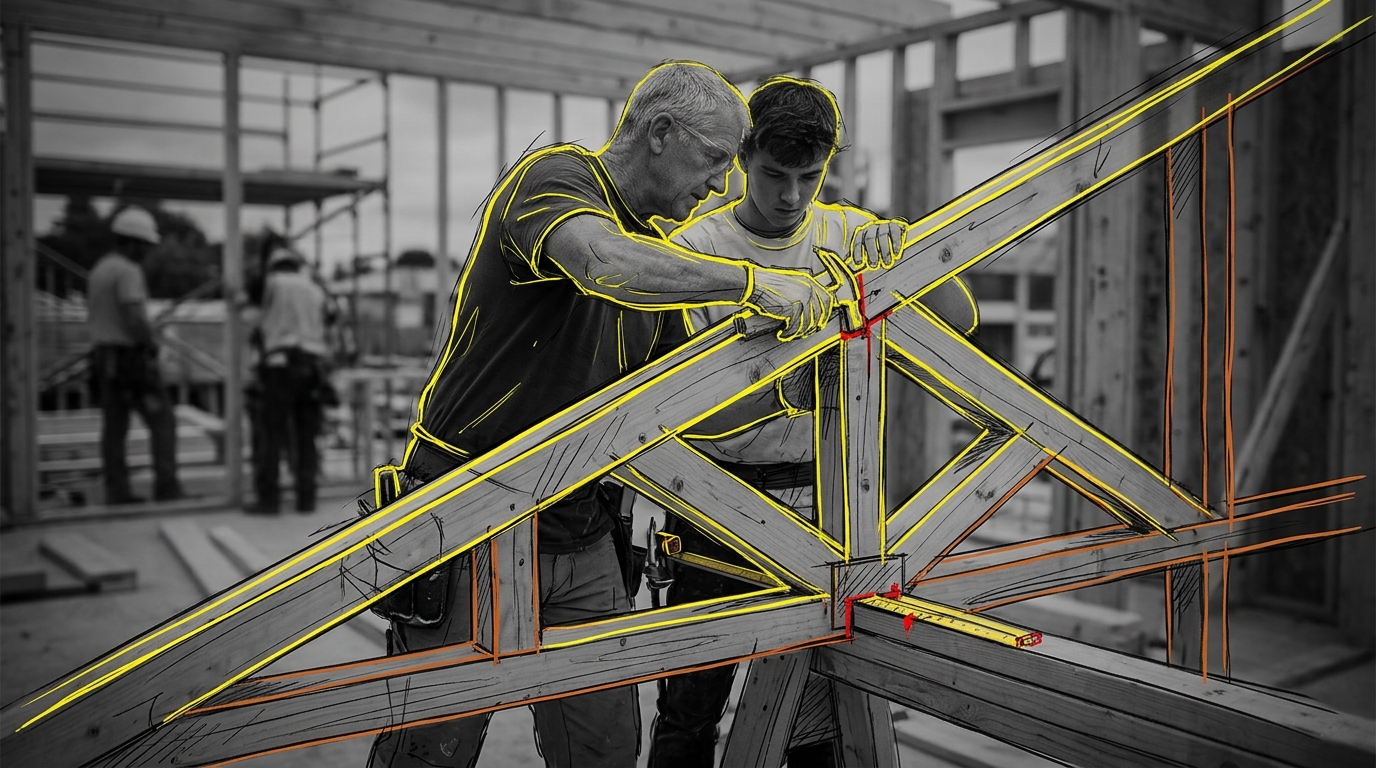
Carpenters typically learn the trade on the job and through apprenticeships. That's from the U.S. Bureau of Labor Statistics, in Carpenters: Occupational Outlook Handbook.
Construction laborers and helpers learn on the job too, according to the Bureau. Formal schooling is not typically required, though some employers may prefer to hire people who have a high school diploma or the equivalent. You'll find that in Construction Laborers and Helpers: Occupational Outlook Handbook.
When you size up a crew, put real, proven hands-on experience ahead of everything else. That experience is what you're hiring for, so a crew's actual work history is the first thing to check.
What OSHA 10- and 30-Hour Training Tells You About a Crew
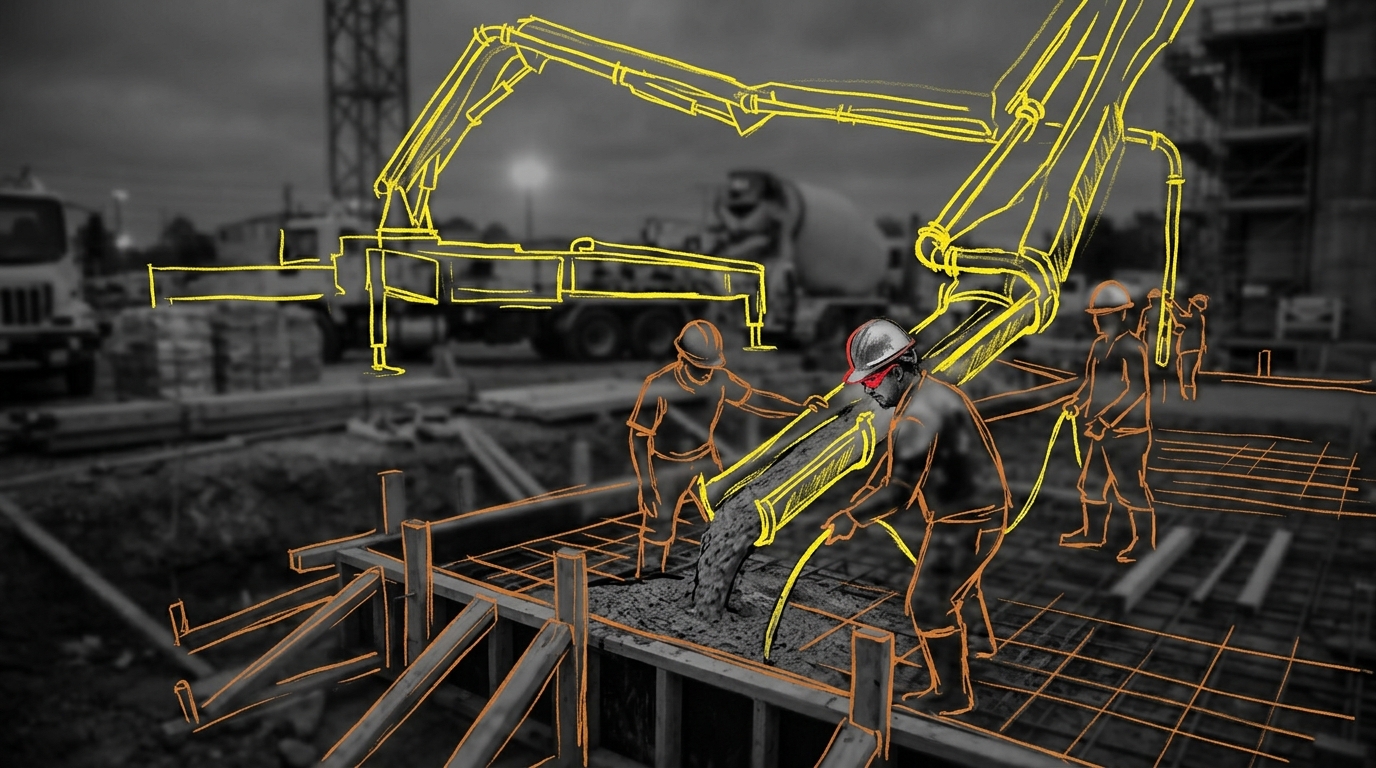
The Occupational Safety and Health Administration (OSHA) offers Outreach safety courses in two lengths: 10 hours and 30 hours. OSHA says the 10-hour program is "primarily intended for entry level workers." The 30-hour program is meant to give workers with some safety responsibility a greater depth and variety of training.
As a general contractor (GC), you can ask a worker which of these courses they've taken. Construction Help Finder (CHF) mentions them only as training a worker may list or an employer may ask about. They are never a requirement of the platform.
Plenty of people claim they can handle expert-level work when they can't, so don't treat a training card as proof of skill. Real ability shows up fast once work starts. Before you hire, ask for details about projects the person has actually finished. For more on this, read How to Judge a Framer's Tool Proficiency Without Seeing Them Work.
What a Framing Subcontractor Must Show to Stand Apart From You

California Labor Code §2781 lists things a construction subcontractor must do. Two of them are about the sub's own business setup.
The first is a separate business location. The law says the subcontractor "maintains a business location that is separate from the business or work location of the contractor."
The second is financial responsibility. The subcontractor takes on financial responsibility for errors or omissions in its labor or services. It can show this with insurance, legally allowed indemnity promises, performance bonds, or warranties for the labor or services it provides.
Ask the sub to show you both. Then read What to Do After You've Connected With a Framing Crew for the next steps. You can also read Reaching Wood and Metal Framers Directly: What to Know Before You Start.
How a GC Becomes Liable for a Framing Sub's Unpaid Wages
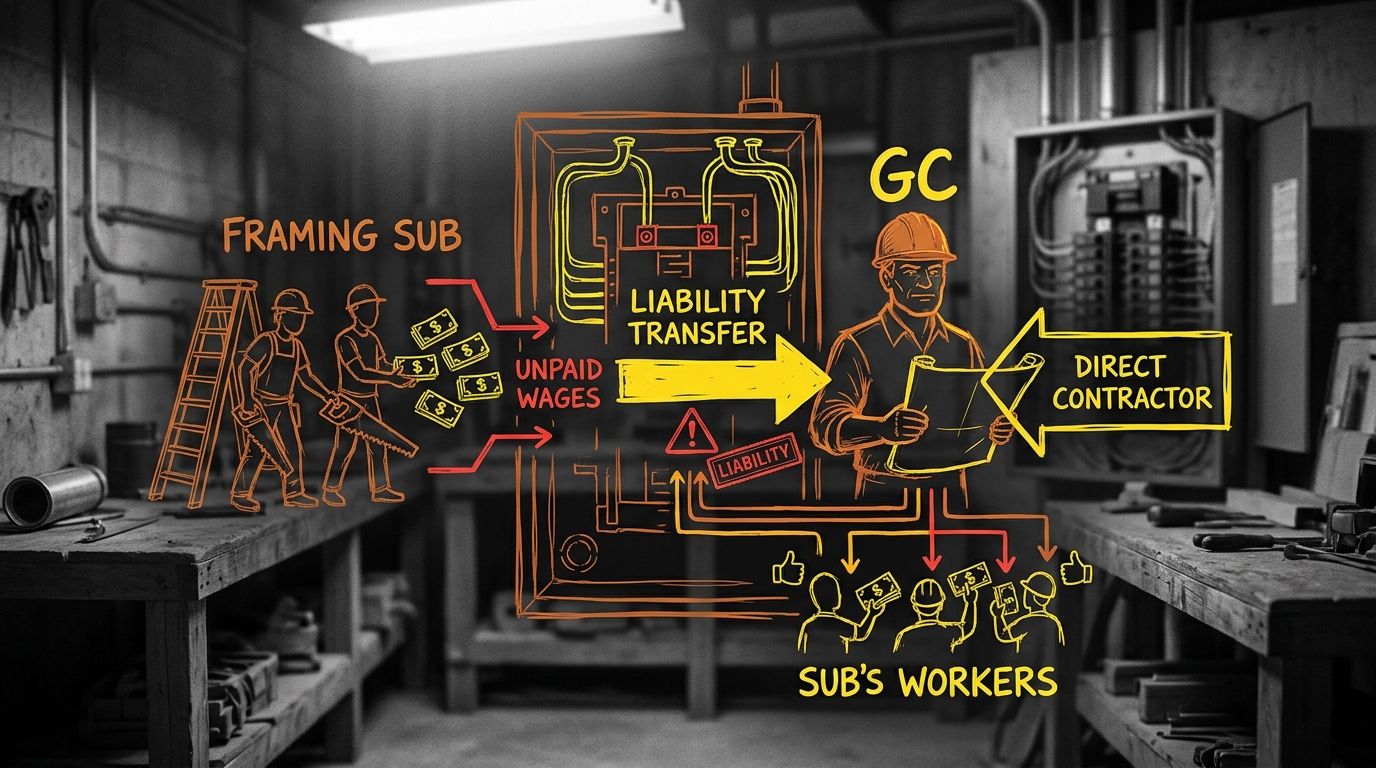
If you're the direct contractor, you can end up owing your sub's wage debts. The California Senate Judiciary Committee describes a rule that says a direct contractor who makes or takes a contract to build, change or repair a building or other private work must take on, and be responsible for, any debt owed to a worker. That includes debt owed to someone else on the worker's behalf. The debt can come from a subcontractor at any tier working for you. The details are in the Senate Judiciary Committee analysis, SB 597 (2025).
The analysis also says that under existing California law, a direct contractor must monitor whether the sub pays its employees' wages and benefits, or pays into the labor trust fund. The contractor does this by periodic review of the sub's payroll records, as the law specifies.
I don't take shortcuts, and I don't skip the payroll checks. Skimping now just sets up liability later. I'd rather do the work right the first time, because fixing and redoing it costs more.
I also treat a very low bid with suspicion. I go by the rule that price tracks quality. When a bid looks too low to cover the crew's wages, I assume something got skipped somewhere. A cheap number isn't a bargain. It's the shortcut showing up in the price.
Cal/OSHA Framing Safety Rules the Crew Must Follow
I won't bend on quality or cut corners on a jobsite. I won't take on the legal and financial exposure if the work fails, and I believe doing it right is the ethical way to work. On a framing job, safety rules aren't a pricing option. They're non-negotiable.
Two rules apply, one for each type of framing. The table below shows each framing type, what triggers the rule, and the protection or steps required.
| Framing Type | Trigger/Threshold | Required Protection or Procedure |
|---|---|---|
| Residential-type framing | Walking/working on top plates, joists, rafters, trusses, beams or similar members 6 feet or more above grade or floor level | Fall protection by one or more of the methods the rule lists |
| Residential-type framing | Exposure to fall hazards | Training to recognize fall hazards and the procedures to minimize them, documented per Section 3203 |
| Residential-type framing | Working from or walking on top plates, joists, rafters, trusses, beams or other structural members | Not allowed until securely braced and supported |
| Residential-type framing | Manually raising framed walls 15 feet or more in height | Temporary restraints, such as cleats or straps, to prevent inadvertent horizontal sliding or uplift of the wall bottom plate |
| Non-residential structural wood framing | Erection procedure | Site-specific written erection procedure prepared by a qualified person, implemented under the direct supervision of a competent person |
| Non-residential structural wood framing | Walking/working on surfaces 15 feet or more above a lower level | Guardrails (Section 1620), a safety net, a personal fall protection system, or other methods specified in Article 24 |
If you need framers for your crew, see Carpenters & Framers. The Job Board for Contractors | Construction Help Finder page explains how the work is done.
Residential-Type Framing
The rule is in Title 8 CCR §1716.2 — Residential-type Framing Activities, Wood and Light Gage Steel Frame Construction. The California Department of Industrial Relations says residential-type framing includes framing of commercial buildings that use traditional wood frame materials and methods.
- Fall protection: When employees walk or work on top plates, joists, rafters, trusses, beams or similar structural members 6 feet or more above the ground or floor below, they must have fall protection by one or more of the methods the rule lists.
- Training: Employees exposed to fall hazards must be trained, following Sections 1509 and 3203, to recognize the fall hazards in the work they will do. They must also be trained in the steps to lower those hazards. The training must be documented, following Section 3203.
- Bracing: Employees may not work from or walk on top plates, joists, rafters, trusses, beams or other structural members until they are securely braced and supported.
- Wall raising: Before framed walls 15 feet or more tall are raised by hand, temporary restraints must go in, such as cleats on the foundation or floor system, or straps on the wall bottom plate. They stop the bottom plate from sliding sideways or lifting up by accident.
Non-Residential Structural Wood Framing
The rule is in Title 8 CCR §1716.1 — Structural Wood Framing Systems.
- Written plan: A qualified person must prepare a written erection procedure made for that exact job site. It must be carried out under the direct supervision of a competent person.
- Fall protection: Employees on surfaces 15 feet or more above a lower level must be protected from falls. The protection can be guardrails as described in Section 1620, a safety net, a personal fall protection system, or other methods listed in.
Frequently Asked Questions
Can a GC require payroll records from a framing subcontractor?
The Senate Judiciary Committee analysis says that when a direct contractor asks, a subcontractor and lower subcontractors must give payroll records. At a minimum, the records must have certain listed information about the employees doing the work on the private job.
What should a GC get from a framing sub before final payment?
The Senate Judiciary Committee analysis says that before making final payment to the subcontractor, the contractor must get an affidavit from the subcontractor saying all workers have been properly paid.
Which heat rules apply when a crew frames outdoors?
California's heat rule for workplaces (Title 8 §3395) sets two temperatures, and each one starts a different duty. When the outdoor temperature in the work area is above 80 degrees Fahrenheit, the employer must have and keep one or more shaded areas at all times while employees are there. The shade must be open to the air or have ventilation or cooling. When the temperature is 95 degrees Fahrenheit or hotter, the employer must put high-heat procedures in place. Ask your crew how they plan to meet both.
Does Construction Help Finder check a framer's license or training?
No. CHF does not require a licence from either side, and it does not do any screening. Any check of a framer's licence or training is yours to make. I keep a small charge on the platform on purpose. I use it to keep out freeloaders and opportunists who would lift contacts or ideas, and to protect the platform's intellectual property. I set it up as a gate, not as a money grab.
Does the structural wood framing rule cover house framing?
Not house framing. The rule covers the work and methods for putting up mostly flat (horizontal) wood framing systems, including panelized roof systems. These are typically used in non-residential buildings such as warehouses, gymnasiums, shopping malls or similar buildings. Residential-type framing has its own rule, set out above.
Before You Commit to a Framing Crew
Before you commit, check five things. Look at the crew's real work history. Ask about training, like the OSHA 10-hour and 30-hour Outreach courses. Make sure the sub stands apart from you. Know what wage debt you could face. Ask how the crew works on safety. Construction Help Finder is a job board that connects Southern California construction employers with skilled trade workers. It does not require a licence from either side and does not screen anyone, so every check is yours to make. The OSHA courses are never a requirement of the platform. Ready to find skilled trade workers for your next crew? Get Started