
Negotiating Pay Rates With Framing Crews Before the Job Starts
One kind of piece-rate plan pays carpenters by the linear foot on framing jobs. In California, a piece-rate must be based on a figure that can be worked out and that is paid for finishing a particular task or making a particular piece of goods. Under California Labor Code section 2810, a construction labor contract must state the total number of workers, the total amount of all wages to be paid, and the date or dates when those wages are to be paid. It must also describe the labor or services and say when they will start and finish.
How Framing Crews Are Paid: Hourly, Piece Rate or Both
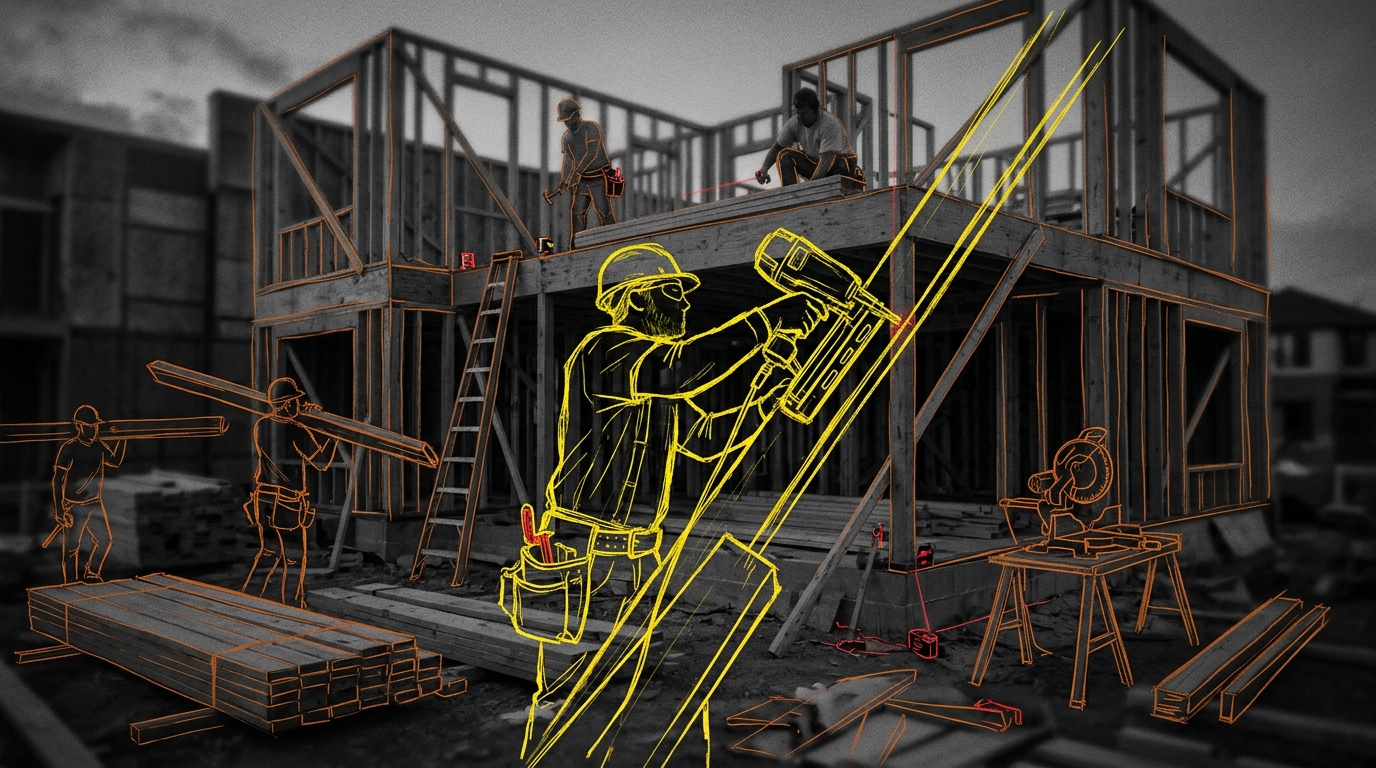
You can pay a framing crew in more than one way. Here are the pay plans the Department of Industrial Relations describes.
Pay by the linear foot is one of them. The Department's example of a piece-rate plan is carpenters paid by the linear foot on framing jobs.
In California, a piece rate has to be based on a figure that can be worked out. It's paid for finishing a particular task or making a particular piece of goods. Pay per linear foot of framing fits that rule.
A piece-rate plan can also cover a group. The group of employees shares the wage earned for finishing the task or making the product. If you hire a whole crew, that is a plan you can put on the table.
You can also mix piece rate with hourly pay. Piece-rate and commission plans may be paid on top of an hourly rate or a salary, or they may be paid instead of one. So you can pick hourly, piece rate, or both.
Carpenter Wage Benchmarks for Southern California
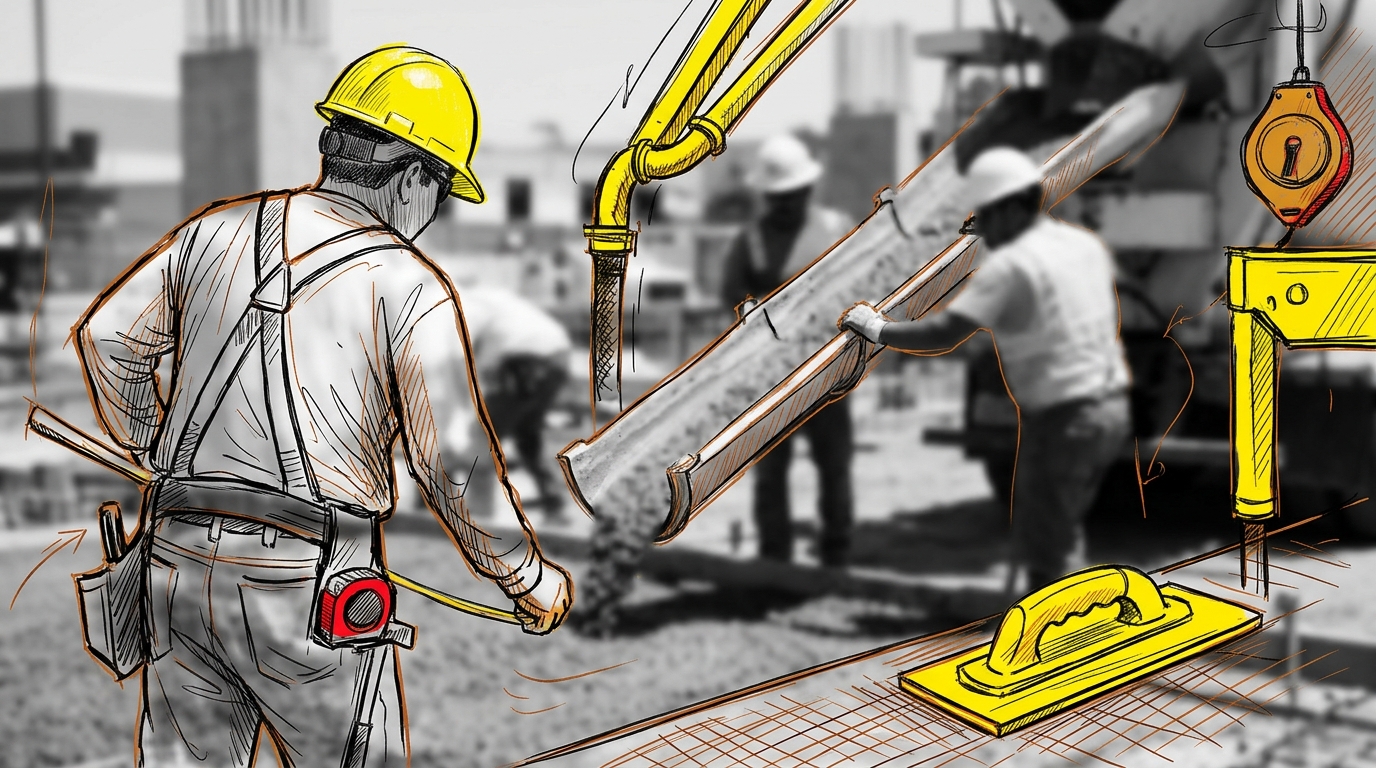
Numbers help you set a fair rate before you talk. This table puts national, California and Los Angeles-area carpenter wages next to the prevailing wage for Southern California.
| Source/Classification | Basic Rate | Total/Mean Rate | Coverage |
|---|---|---|---|
| National median carpenter wage, May 2023 | $27.09/hr median | $56,350/yr median | U.S. |
| California carpenters, May 2023 | $35.28/hr | $73,370/yr mean | California |
| LA-Long Beach-Anaheim carpenters, May 2023 | $35.06/hr | $72,920/yr mean | About 26,400 carpenters |
| Carpenter, prevailing wage determination 2026-1 | $52.24/hr basic | $81.32/hr total | All localities in 11 listed counties |
| Pneumatic nailer or power stapler, prevailing wage determination 2026-1 | $52.37/hr basic | $81.45/hr total | All localities in 11 listed counties |
Use these figures as your yardstick when a bid comes in. If a rate lands well under them, ask what's behind the number before you say yes.
You can read more about the trade on the Carpenters & Framers page. To see how the work is done, the Job Board for Contractors | Construction Help Finder page explains it.
Market Wages: National, California and Los Angeles
The U.S. Bureau of Labor Statistics gives pay figures for carpenters in May 2023. Nationally, the pay was spread like this:
- At the 10% mark: $18.00 an hour, or $37,440 a year.
- At 25%: $22.18 an hour, or $46,130 a year.
- At 50%, the median (the middle): $27.09 an hour, or $56,350 a year.
- At 75%: $34.75 an hour, or $72,290 a year.
- At 90%: $45.47 an hour, or $94,580 a year.
In California, the annual mean (average) wage for carpenters was about $73,400 ($73,370), or $35.28 an hour.
The Los Angeles-Long Beach-Anaheim area had about 26,400 carpenters. Their pay was $35.06 an hour, and the annual mean (average) wage was about $72,900 ($72,920).
Prevailing Wage on Public Works
The Department of Industrial Relations, Office of the Director, publishes prevailing wage determinations for Southern California. The Index 2026-1 Southern California basic trade journeyman rates lists them. The Carpenter General Prevailing Wage Determination SC-23-31-2-2026-1 (Southern California) holds the details.
- Carpenter: The row for Carpenter also lists Cabinet Installer, Insulation Installer, Hardwood Floor Worker and Acoustical Installer. The basic hourly rate is about $52 ($52.24). The total hourly rate, with employer payments, is about $81 ($81.32).
- Pneumatic Nailer or Power Stapler: The basic hourly rate is about $52 ($52.37). The total hourly rate is about $81 ($81.45).
The determination covers all localities inside Imperial, Inyo, Kern, Los Angeles, Mono, Orange, Riverside, San Bernardino, San Luis Obispo, Santa Barbara and Ventura counties.
It sets overtime rules too:
- Monday through Friday, all overtime is paid at 1 1/2 times the straight time rate for the first four hours. Work performed after twelve hours is paid at double (2x) the straight time rate.
- On Saturday, the first eight hours worked are paid at 1 1/2 times the straight time rate. All hours after that are paid at double (2x) the straight time rate.
California's Rules When You Pay Framers by Piece Rate
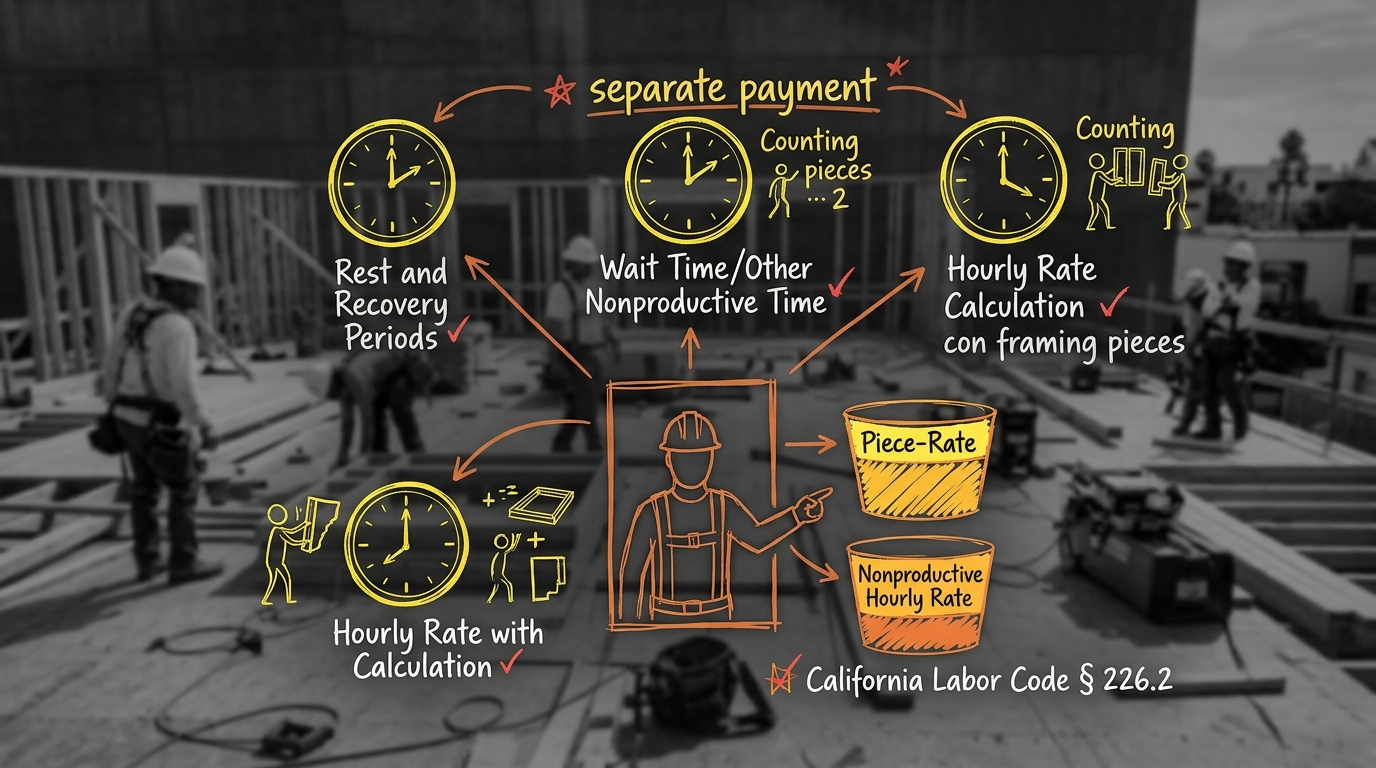
California Labor Code section 226.2 says you must pay for rest and recovery periods and other nonproductive time separately from any piece-rate pay. They are their own pay, not part of the piece rate.
For this section of the law, "applicable minimum wage" means the highest of the federal, state or local minimum wage that applies to the job.
The Department of Industrial Relations explains the rule in its Frequently Asked Questions – Piece-Rate Compensation, Labor Code §226.2 (AB 1513). The law itself is California Labor Code section 226.2.
Rest and Recovery Periods
An employer may not treat piece-rate pay as if it already includes pay for rest and recovery periods. That is true no matter how the piece rate was set.
Pay for rest and recovery periods must equal the hourly rate the employee earned for work time that week, averaged over the workweek. If that average comes out below minimum wage, you pay minimum wage.
Here is how to find the average hourly rate:
- Take the total pay for the workweek.
- Leave out pay for rest and recovery periods and any extra overtime pay.
- Divide that by the total hours worked in the workweek, leaving out rest and recovery periods.
Going forward, the law requires pay at this average hourly rate.
If you've authorized and permitted two 10-minute rest periods during a shift, the paid rest and recovery periods are the ones authorized and permitted under existing law.
If you pay on a semi-monthly basis (twice a month), you have another option. The law lets you pay for rest and recovery periods at a rate of at least the minimum wage for the pay period when those periods occurred. Then you do a "true up" of the pay that is owed.
Other Nonproductive Time
Labor Code section 226.2 defines "other nonproductive time." It is time under the employer's control, not counting rest and recovery periods, that is not directly related to the work being paid by the piece.
The pay rule is simple. Pay other nonproductive time at an hourly rate that is no less than the applicable minimum wage.
You can set the amount of this time two ways: through actual records, or through your reasonable estimates of the other nonproductive time worked during the pay period. Either one can be done for a group of employees or for one employee.
There's also another way to comply. If you pay piece-rate pay and also pay an hourly rate of at least the applicable minimum wage for all hours worked, you're treated as following paragraph (4), the rule on pay for nonproductive time.
Put the Crew Agreement in Writing Before Work Starts
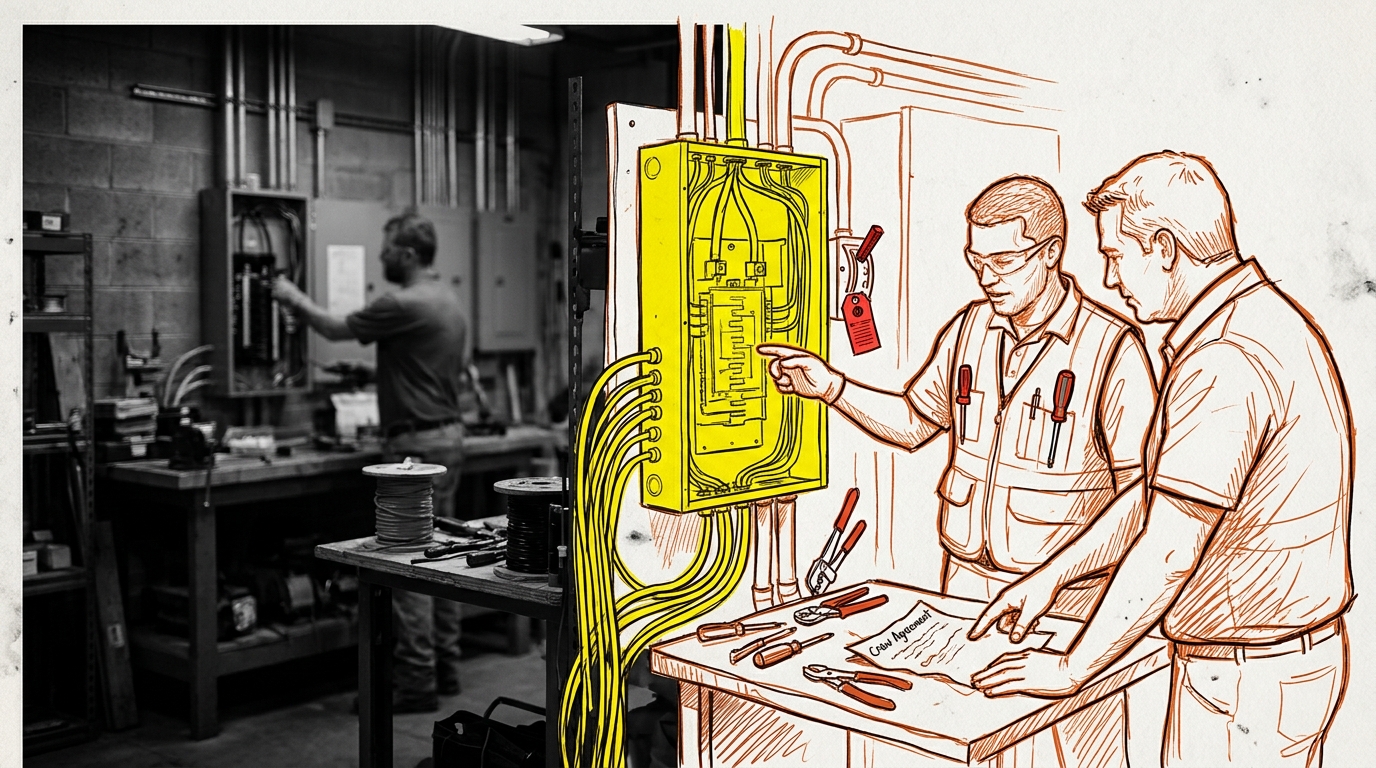
Get the crew agreement down in writing before anyone starts work. California law spells out what that contract has to say, and the list is below.
Construction Help Finder connects employers with skilled trade workers, then gets out of the way. The deal is yours to write, and California law has rules for what it must say. For the next steps, read What to Do After You've Connected With a Framing Crew.
The rules are in California Labor Code section 2810:
- Enough money: You can't enter into a contract for labor or services with a construction contractor if you know or should know the contract does not include funds sufficient for the contractor to comply with all applicable local, state and federal laws or regulations that govern the work. The same rule covers farm labor, garment, janitorial, security guard, port drayage motor carrier and warehouse contractors.
- Workers and wages: The contract must state the total number of workers to be employed under it, the total amount of all wages to be paid, and the date or dates when those wages are to be paid.
- The work and the dates: It must also describe the labor or services to be provided and state when they are to be started and finished.
- Things you don't know yet: If an item required by paragraph (7) or (9) of subdivision (d) is unknown when the contract is signed, the best estimate available at that time is enough.
- Keep a copy: Keep the written contract for at least four years after the contract ends.
- Damages: An employee hurt by a violation of subdivision (a) of section 2810 can file a lawsuit for damages. The employee can recover whichever is greater: all of the employee's actual damages, or $250 per employee per violation for a first violation and $1,000 per employee for each later violation.
Withholding Disputed Payments From a Framing Subcontractor
Labor Code section 218.7 does not stop a direct contractor, or a subcontractor at any tier, from setting terms by contract. It also doesn't stop them from enforcing other lawful remedies against a subcontractor they hire. This covers liability created when that subcontractor doesn't pay wages, fringe or other benefit payments, or contributions.
For any contract entered into on or after January 1, 2019, there's one more step. If you're a direct contractor and want to withhold payments as disputed, you must state in your contract with the subcontractor the specific documents and information you'll require the subcontractor to provide.
That means you write it into the subcontract up front. You can also read Evaluating a Lead Framer's Crew Before You Commit. The law is California Labor Code § 218.7.
Frequently Asked Questions
Does overtime still apply when a framer is paid by the linear foot?
Yes. In any workweek when a piece-rate employee worked overtime hours, you must figure and pay overtime according to existing law. Check the week's hours before you pay out the piece rate.
What if I make an honest mistake figuring nonproductive time?
You still have to pay the wages for all hours worked in that other nonproductive time. If the conditions for a good faith mistake are met, you don't owe the civil penalties set by law. Fix the pay and pay what is owed.
Does the written-contract rule apply to union framing crews?
No, not if you sign a collective bargaining agreement (a union contract) that covers the workers employed under the contract. The rule leaves out a person or business that does that. If you have no such agreement, put the contract in writing.
How long does a prevailing wage rate stay in effect?
A prevailing wage ruling stays in effect until the Director of Industrial Relations has it canceled, modified or superseded by a new ruling. A new ruling becomes effective 10 days after it is issued. Check for a new ruling before you set a rate.
Do prevailing-wage jobs require travel or subsistence pay?
Yes. Under Labor Code Sections 1773.1 and 1773.9, contractors must make travel and/or subsistence payments to each worker to do the work. Plan for that cost when you set your rate.
Pick the Pay, Check the Numbers, Sign Before Day One
Pick the pay structure first: hourly, piece rate or both. Check it against the benchmarks. Then agree to it in writing before day one. The contract must state the total number of workers, the total amount of all wages to be paid, and the date or dates when those wages are to be paid. Construction Help Finder connects employers with skilled trade workers, then gets out of the way, so the deal is yours. Ready to post your framing job or find framing work? Get Started.